For Mount Sinai Community & Visitors
Medical Education Change Targets
Driving change to eliminate racism and bias, fostering a diverse, inclusive environment.
Where we started
In 2018, the guiding coalition of the Medical Education Racism and Bias Initiative conducted a series of exploratory meetings and surveys with students, faculty, staff, and other stakeholders across the Mount Sinai Health System. This process helped identify initial change targets and incremental outcomes that strategically support our vision of becoming a health system and health professions school with a diverse workforce, dedicated to delivering healthcare and education free from racism and bias. Each year, the coalition course-corrects existing targets while establishing new ones to strengthen and realign efforts toward the vision.
Transforming six key conditions
Starting in 2021, the Medical Education guiding coalition has focused change targets on transforming six key conditions that perpetuate racism and other interconnected systems of oppression. Although these factors are often less visible, they play a significant role in facilitating meaningful systemic change.
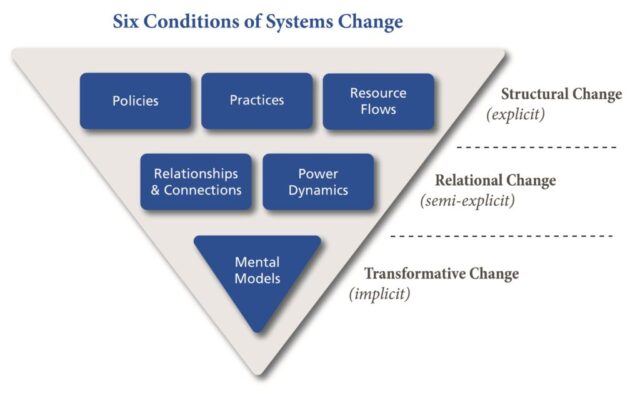
Learn more about these six conditions by reading this article: Kania J, Kramer M, Senge P. The water of systems change. Stanford Social Innovation Review. 2016;14(3):36-41.
What’s new for 2025?
The Medical Education Guiding Coalition is excited to introduce the 2025 Change Targets! This year, we’ve set 19 actionable, outcome-driven goals focused on challenging and transforming the six key conditions that uphold racism and other interlocking systems of oppression in our work and learning environments. These conditions are often subtle, but they are among the most influential forces shaping the systems we seek to change. Many of this year’s targets build on last year’s efforts, while others introduce new structures and strengthen key relationships. We’re eager to continue this journey together and invite you to join us in making meaningful progress.
2025 Medical Education Change Targets
Structural Change
- Develop and deliver tailored unconscious bias training for all incoming Medical Education staff, ensuring improved awareness and application in their roles | Resource Sphere
- Expand and disseminate the anti-racist resource inventory across schools, departments, and disciplines, ensuring broad accessibility and engagement | Resource Sphere
- Report on a comprehensive evaluation of the PREview Situational Judgement Test, analyzing its effectiveness and equity in the admissions selection process | Admissions Sphere
- Integrate equity and justice feedback data and Mount Sinai Health System's strategic priorities to align Chats for Change topics, ensuring relevance and impact | School-wide Sphere
- Create and launch the Unity in Action programming, starting with a focus on addressing religious-based oppression, with impact on community awareness and engagement | School-wide Sphere
- Convene stakeholders to evaluate and identify actionable improvements in current practices for addressing the impact of social issues on the Icahn Mount Sinai work and learning environment | School-wide Sphere & GSBS Guiding Coalition
- Revise and standardize the diversity statements across the Icahn School of Medicine to ensure consistency and promote parity | School-wide Sphere
- Integrate instructional activities aligned with the Anti-Oppression Medical Education Program Objective (MEPO) into ASCEND Phase 1 modules, ensuring they support module objectives and curricular goals | Curricular Affairs Sphere
- Develop and implement an assessment framework to evaluate the effectiveness of instructional activities aligned with the Anti-Oppression MEPO in ASCEND Phase 1 modules | Curricular Affairs Sphere
- Conduct a baseline survey of Clinical Competency Mentors’ antiracist skills and provide targeted training to enhance their ability to teach clinical skills with an antiracist approach | Curricular Affairs Sphere
- Ensure all new ASCEND Module Directors, Clerkship Directors, and Clinical Competency Mentors complete required antiracism training and demonstrate its incorporation into their curriculum development and pedagogical practices as part of periodic Executive Oversight Committee curriculum reviews | Curricular Affairs Sphere
- Implement a mechanism to track policy utilization that will allow medical education to address disparities in academic outcomes for medical students | Medical School-wide Sphere with Student Affairs, Curricular Affairs, and Continuous Quality Improvement (CQI) team.
Relational Change
- Strengthen recruitment efforts by expanding engagement with premedical affinity groups, pathway programs, and targeted institutional outreach to increase diversity in applications | Admissions Sphere
- Expand the Health Equity Journal Club model to other departments within the Mount Sinai Health System | Clinical Sphere
- Establish a collaborative partnership with the Department of Psychiatry on the West Side, supporting their initiatives to enhance departmental efforts and impact | Clinical Sphere
- Sustain collaboration with the Department of Social Work to support and advance their anti-bias and anti-racism efforts, ensuring continued progress | Clinical Sphere
- Leverage the success of Chats for Change to expand and deepen collaboration with MSHP, driving further impact and engagement | Clinical Sphere
- Identify and establish at least one potential area of collaboration through outreach to clinical departments | Clinical Sphere
Mental Model Change
- Promote the adoption of an appreciative advising mindset among faculty advisors to promote strength-based focus, goal-oriented conversations, and collaborative partnerships with medical students | Student Affairs Sphere